
What Matters When Sourcing Tool Boxes for Your Business?
A reliable sourcing decision begins with a product that fits your customers’ needs and a supplier that can document how it will be produced. When evaluating a tool box manufacturer, compare the complete specification, sample quality, packaging and order conditions alongside the unit price.
For importers, hardware distributors and private label brands, several details deserve particular attention: usable internal space, storage layout, handle construction, closure operation and consistency between the approved sample and the shipment.
Whether you are exploring metal tool box wholesale options or developing custom metal tool boxes, the following process will help you prepare a clearer inquiry and compare suppliers more effectively.
1. Define Your Product Requirements Before Requesting Quotes
A manufacturer can prepare a more relevant proposal when the intended application is clear. Start with the customers you serve and the tools they need to store.
A toolbox sold empty through hardware retailers requires a different purchasing brief from a branded kit containing a fixed selection of tools. In the second case, internal fit and loaded weight become essential approval points.
| Purchasing Requirement | Details to Provide |
|---|---|
| Sales channel | Hardware retail, tool distribution, private label or another defined channel |
| Product configuration | Empty toolbox or a specified tool kit |
| Storage design | Single compartment, cantilever trays or a proposed custom layout |
| Size requirements | External footprint and minimum usable internal space |
| Intended contents | Tool dimensions, quantities and total weight |
| Order quantity | Quantity by model, color and packaging configuration |
| Branding | Logo, finish and packaging requirements |
| Delivery | Destination and required delivery schedule |
Separate essential requirements from preferences. A minimum internal length may be necessary to accommodate a specific tool, while a preferred color may be open to discussion.
Using the same brief for each supplier also makes quotations easier to compare.
2. Select the Right Tool Box Design
Storage layout should reflect how customers organize and access their tools. Single-compartment and cantilever models provide different benefits, so compare their practical use before selecting a product range.
Single-Compartment Metal Tool Boxes
A single-compartment toolbox offers an undivided interior for tools of different shapes. Its simple layout can suit buyers who want flexible storage without fixed tray sections.
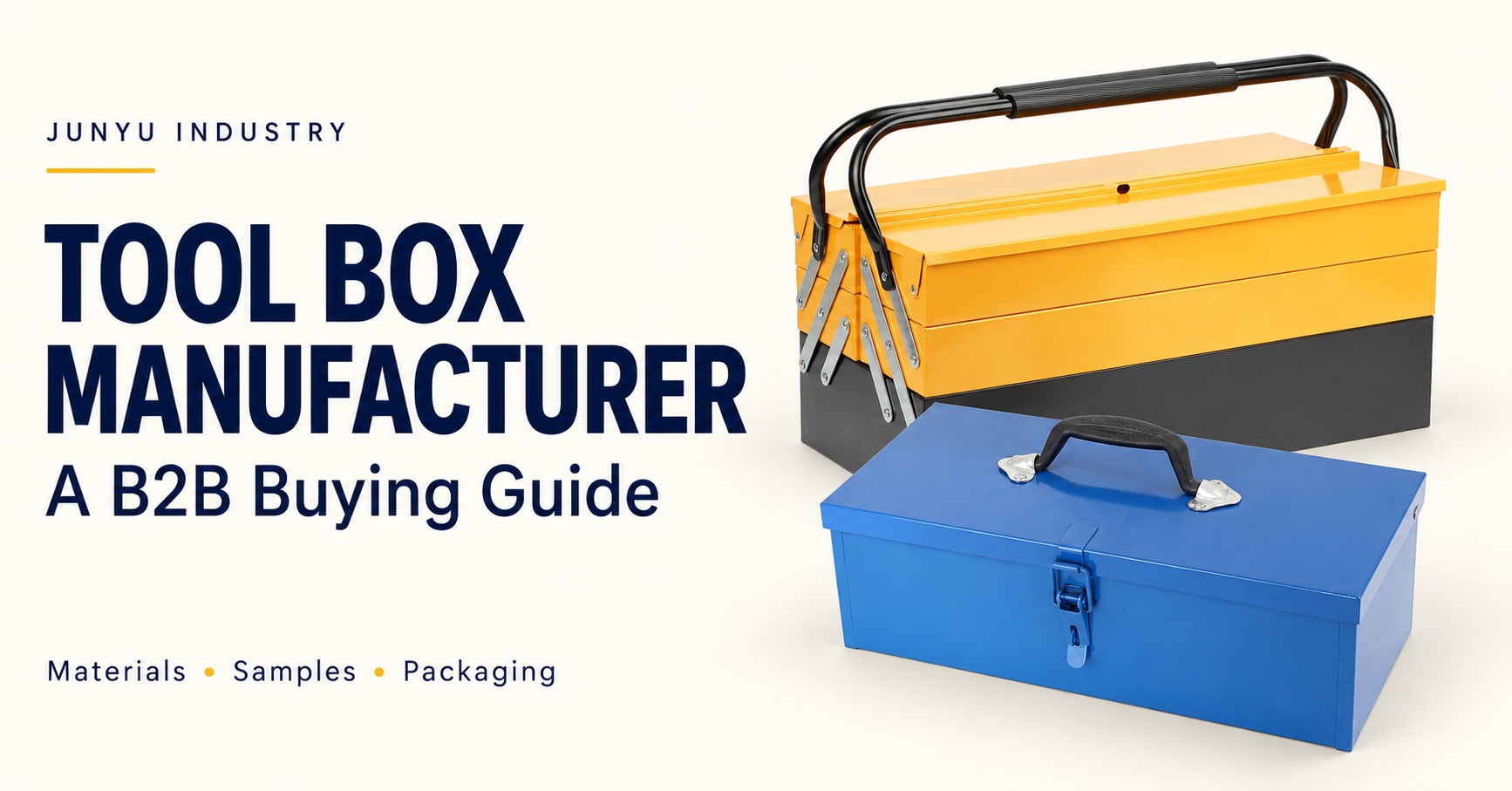
The JY2013 portable metal tool box features a hinged lid, folding top handle and front latch. Its listed external dimensions are 38.5 × 17.2 × 14.2 cm.
For this format, confirm internal length, width and lid clearance. If small accessories require separate organizers, specify whether those organizers are included in the order.
Cantilever Metal Tool Boxes
A cantilever toolbox uses linked trays that extend outward, exposing separate storage areas above a deeper base. This arrangement helps users group smaller tools and accessories.
The JY2011 three-tier metal cantilever tool box has five compartments and listed dimensions of 42 × 20 × 20 cm. Junyu also lists a 46cm three-tier metal cantilever tool box, measuring 46 × 22 × 22 cm.
Both product pages specify 0.6 mm powder-coated iron sheet. Internal tray dimensions and rated carrying capacity should be confirmed for the intended order.
| Selection Factor | Single-Compartment Toolbox | Cantilever Toolbox |
|---|---|---|
| Interior arrangement | One open storage area | Upper trays and a deeper base |
| Tool organization | Flexible placement | Separate compartments for grouping items |
| Access | Direct access through the top lid | Trays extend outward to expose contents |
| Space during use | Clearance for the lid | Clearance on both sides for tray extension |
| Key sample checks | Internal fit, lid, latch and handle | Tray movement, linkages, lids and handles |
| Junyu examples | JY2013 | JY2011 and the 46cm model |
Choose the design around the intended contents. More compartments may improve organization, but compartment dimensions can also limit which tools fit.
3. Evaluate Construction Beyond Sheet Thickness
Material thickness provides a useful comparison point, but it does not establish the performance of the complete toolbox. Handles, hinges, fasteners, joints and closures also need evaluation.
Confirm Materials and Finish
Request the material specification, nominal thickness and surface treatment. Ask whether the body, lid and trays use the same material and thickness.
For coated products, agree on the color reference and review the sample for coverage, scratches, exposed areas and finish consistency.
If corrosion resistance is a purchasing requirement, request an agreed test method and relevant results. A powder-coated surface alone does not establish a specific corrosion-resistance rating.
Check Handles, Hinges and Closures
Inspect accessible edges and confirm that the lid aligns with the body. Open and close the toolbox repeatedly to assess movement and closure engagement.
Check handle attachment, hand clearance and movement. For cantilever models, operate the trays through their full travel and look for interference between components.
If customers require padlock compatibility, verify the closure with the intended lock dimensions rather than relying on photographs.
Verify Carrying Capacity
Ask the tool box manufacturer for the rated carrying capacity and the method used to establish it.
For bundled kits, evaluate the approved configuration with the intended contents under an agreed procedure. Consider total loaded weight, distribution of heavier tools, handle operation and secure closure.
Do not estimate carrying capacity from external dimensions or empty product weight.
4. Use Sample Approval to Establish a Production Reference
Sample approval should produce a documented reference for the order. Record what has been accepted, which changes remain necessary and whether a revised sample is required.
| Inspection Area | What to Record |
|---|---|
| Dimensions | Agreed measurements, tolerances and internal clearances |
| Construction | Materials, thicknesses and component arrangement |
| Surface finish | Color reference and acceptable visible appearance |
| Operation | Handle, hinge, latch and tray movement |
| Carrying performance | Agreed capacity and verification procedure |
| Branding | Artwork, dimensions, position and appearance |
| Included contents | Accessories, instructions or a defined tool assortment |
| Packaging | Protection, packing arrangement and labels |
Identify the approved sample and specification revision. Keep photographs alongside the written record, particularly for branding, surface finish and packaging details.
Ask the supplier to obtain approval before making substitutions. A change to a handle, latch or packing material may affect the product even when its model number remains the same.
Also agree on a production inspection plan. The approved sample defines the target, while inspection provides a way to check the shipment against it.
5. Clarify the Scope of Custom Metal Tool Boxes
Customization can involve branding an existing model or developing a different structure. Explain which type of project you need before comparing costs and timelines.
Branding an Existing Model
For an established toolbox, discuss available logo methods, colors, labels and packaging formats.
Provide artwork with placement and size instructions. Confirm the minimum quantity, additional charges and approval process for the selected configuration.
Review the branding on a suitable proof or sample before authorizing production.
Developing a Modified Structure
Changes to dimensions, trays, handles or closures may require drawings, tooling and additional evaluation.
For custom metal tool boxes, confirm:
-
Which requested changes are feasible.
-
Who prepares and approves drawings.
-
Whether development or tooling charges apply.
-
Who owns and maintains project-specific tooling.
-
How sample revisions are handled.
-
Which inspections or tests are required.
-
When the design becomes fixed for production.
Junyu’s company information describes drawing- and sample-based development, stamping, assembly and packaging support. Confirm how these stated capabilities apply to the exact product you intend to order.
6. Compare Wholesale Quotations on an Equivalent Basis
A useful price comparison requires equivalent specifications and delivery terms. One quotation may include retail packaging and branding, while another covers only an unbranded product in basic protective packing.
For metal tool box wholesale inquiries, request the following information:
| Quotation Item | Why It Matters |
|---|---|
| Model and specification | Identifies the exact product being priced |
| Quantity by configuration | Clarifies pricing for different models or colors |
| Branding and accessories | Defines what is included |
| Individual and master packaging | Establishes protection and packing costs |
| Sample and tooling charges | Separates development costs from unit pricing |
| Carton dimensions and gross weight | Supports freight and warehouse planning |
| Production lead time | Establishes the expected production period |
| Delivery terms and named location | Clarifies the delivery basis |
| Payment terms and validity | Records the commercial conditions |
Ask what starts the production lead time. Sample approval, artwork approval and receipt of payment may each be relevant milestones.
Confirm how revisions affect the schedule, and distinguish the production period from transit time.
7. Review Packaging for Your Distribution Route
Packaging should protect the approved product through its intended handling and delivery process.
Inspect protection around corners, handles, latches and other contact points. Check whether the toolbox can move inside the package and whether loose components could mark the finish.
For retail products, confirm that the packaging accurately identifies the model, dimensions and included contents. If tools are not included, product presentation should make that clear.
For mixed-model shipments, agree on carton identification and packing-list details. If the product will be shipped individually to end customers, assess that shipping configuration separately.
Any packaging test requirement should be agreed before production and should reflect the actual packing arrangement.
8. Confirm the Order and Repeat-Supply Process
Before issuing the purchase order, check that the quotation, approved sample and production specification describe the same configuration.
Resolve missing details such as carrying capacity, internal measurements or carton information before approval. Keep the final drawings, artwork and packing instructions in one identified order record.
For repeat supply, ask how the manufacturer communicates changes to components, materials, packaging and schedules. Establish who handles technical questions, inspections and quality concerns.
Clear responsibilities and consistent records make future orders easier to manage.
Frequently Asked Questions
What should I ask a tool box manufacturer before ordering?
Start with specifications, internal dimensions, carrying capacity, sample arrangements, minimum order quantity and lead time. Explain the intended contents and sales market so the supplier can assess product suitability.
What is the minimum order quantity for metal tool boxes?
Minimum quantities vary by supplier, model, color and customization scope. Request the requirement for your exact configuration, including branded packaging or structural changes.
Should I choose a single-compartment or cantilever toolbox?
Choose according to the tool assortment and organization needs. A single compartment provides undivided space, while cantilever trays separate contents. Verify fit with the intended tools before selecting either format.
Can I order tool boxes with my own logo?
Ask which branding methods are available for the selected model. Confirm artwork specifications, placement, cost, minimum quantity and sample approval before ordering.
Are tools included with the toolbox?
Confirm this explicitly. An empty toolbox and a complete kit require different contents lists, packaging arrangements and loaded-weight checks.
How can I reduce differences between the sample and shipment?
Use an identified approval sample, written specifications and an agreed inspection plan. Require approval for substitutions and keep a record of all accepted changes.
Discuss Your Tool Box Sourcing Project with Junyu
Junyu’s range includes portable single-compartment tool boxes and three-tier cantilever models for buyers comparing different storage layouts.
To request a relevant quotation, provide your preferred model, quantity, intended contents, delivery destination and packaging requirements. For private label or development projects, include logo artwork, drawings and requested modifications.
Contact Junyu with your sourcing requirements to discuss product specifications, sample arrangements and the configuration needed for your business.