
What Should B2B Buyers Check Before Sourcing Safe Boxes?
Choosing a safe box manufacturer starts with understanding what your customers need to store and which product features you can accurately document. A compact key-operated safe, an electronic keypad model and a safe with interior lighting may belong in the same catalog, but they require different purchasing specifications.
For importers, distributors and private label brands sourcing wholesale safes, appearance and unit price are only part of the decision. Lock operation, usable internal space, construction, mounting provisions and supplied accessories all need review.
This guide explains how to compare products, evaluate an electronic safe supplier and prepare a bulk order with clear requirements.
Define the Intended Use and Product Claims
Begin with the intended application. Will the safe be sold for household storage, personal savings or small-item organization? What contents must fit, and what level of protection does the buyer require?
A product designed to organize small valuables should not automatically be described as fireproof, waterproof or certified against burglary. Those claims require evidence covering the exact model and configuration.
Describe the Contents and Placement
Provide the supplier with the dimensions of items that must fit inside. External measurements do not establish usable capacity because the door, locking mechanism, hinges and shelf can reduce the available space.
Also consider where the product will be placed. A front-opening door needs clearance, and the user must be able to reach the keypad, knob or key cylinder.
Separate Features from Verified Protection
Features such as steel construction, locking bolts and an electronic keypad describe the product. They do not, by themselves, establish a tested security rating.
If your sales channel requires a particular protection claim, ask for the relevant test documentation and confirm that it applies to the ordered model. Keep catalog descriptions consistent with the evidence available.
Compare Mechanical Key Locks and Electronic Keypads
The locking system affects everyday operation, product presentation and the information customers need after purchase.
Mechanical Key Lock Safes
A mechanical key-operated safe provides access without an electronic code. The lock does not require batteries, which removes battery replacement from routine operation.
Junyu’s JY1012 mechanical key lock safe box is listed in two external sizes: 23 × 17 × 17 cm and 31 × 20 × 20 cm.
When evaluating this format, confirm the supplied key quantity, lock operation and replacement-key policy. Check that the instructions explain how customers should store their keys and whom to contact for support.
Electronic Keypad Safes
Electronic models introduce code-based operation and require a clearer review of power requirements, instructions and support procedures.
The JY1011 electronic safe box includes a numeric keypad, rotary knob and key cylinder. Its product page lists two sizes and both coin-slot and non-slot versions.
Before ordering, confirm the battery specification, whether batteries are included, the code-setting procedure and the documented behavior when power is low or unavailable.
| Purchasing Factor | Mechanical Key Lock Safe | Electronic Keypad Safe |
|---|---|---|
| Main access method | Physical key | Electronic code, with additional access options depending on the model |
| Power requirement | No batteries required for the mechanical lock | Confirm the battery or power specification |
| Instructions | Key operation and care | Code setup, power requirements and model-specific operation |
| Sample checks | Key movement, door alignment and lock engagement | Keypad response, documented code functions, power indications and lock engagement |
| Support questions | Lost-key and replacement policies | Operating instructions, power-related questions and authorized support procedures |
| Junyu examples | JY1012 | JY1011, JY1013 and JY1016 |
Select the lock format around customer needs and your support capabilities. A more complex interface is useful only when its operation is clear and properly documented.
Match Product Variants to Your Sales Range
A focused assortment should give customers meaningful choices in size, access method and interior layout.
Compact Electronic Models
The JY1011 is listed in 23 × 17 × 17 cm and 31 × 20 × 20 cm sizes. The page also identifies coin-slot and non-slot configurations.
Specify the required version in the quotation and purchase order. Photographs, packaging and model labels should match the configuration being supplied.
An Alternative Exterior Finish
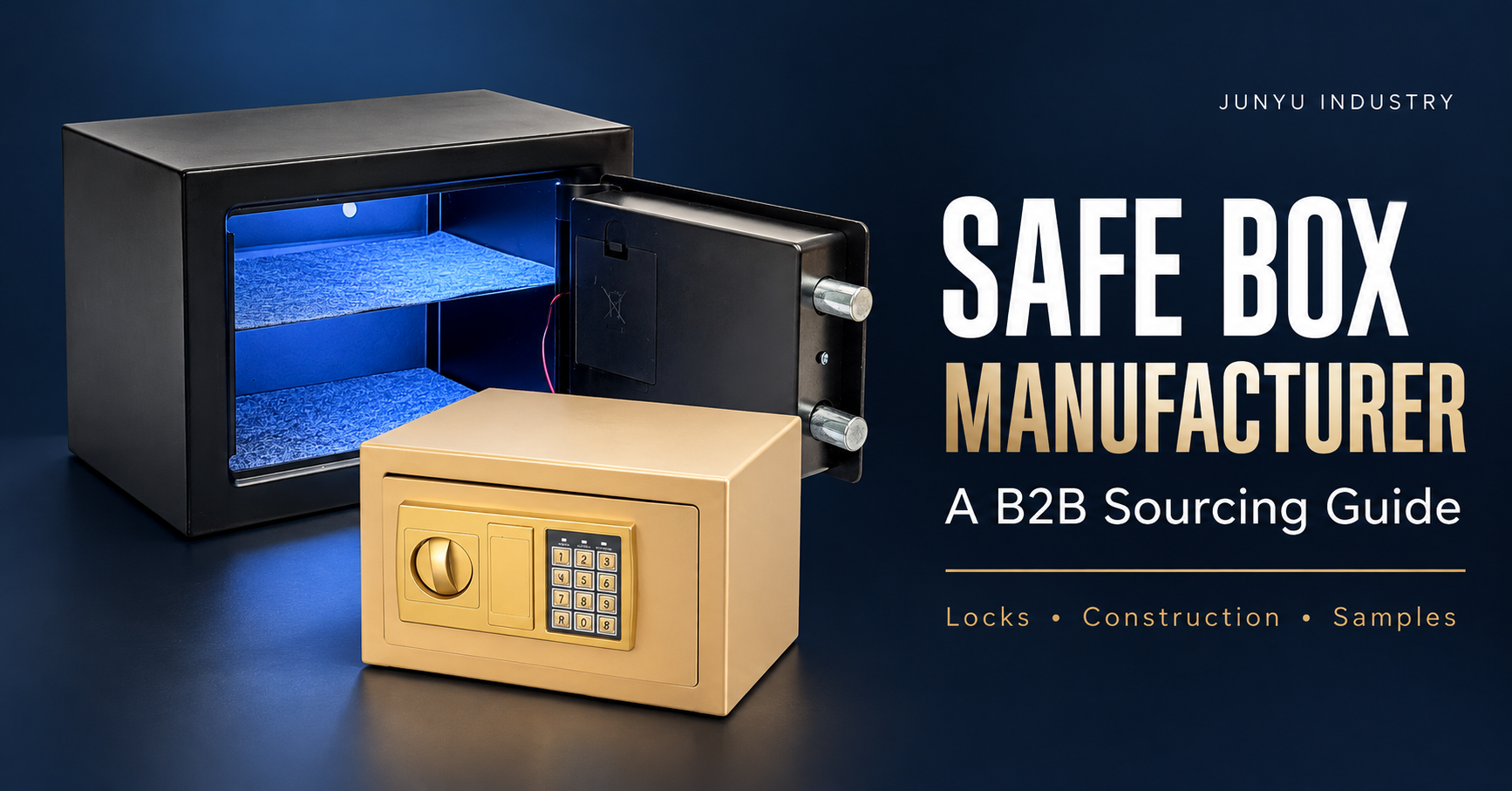
The JY1013 gold electronic safe box has a gold-tone exterior and listed dimensions of 31 × 20 × 20 cm.
Its appearance may help distinguish it within a product range, but buyers should confirm the construction, power requirements and included accessories independently. Similar-looking controls do not establish that two models have identical specifications.
Interior Lighting and a Shelf
The JY1016 digital safe box includes LED interior lighting, one shelf and two felt liners.
These features support a different storage presentation from an undivided interior. Confirm the clearance above and below the shelf, whether the shelf is removable, and how the light operates on the ordered configuration.
Models with Functions Still to Be Confirmed
The JY1014 black safe box shows a key cylinder and a circular front-panel design. Its page leaves electronic or biometric functions unconfirmed.
Treat those functions as unresolved purchasing questions. Do not advertise fingerprint access or other unverified capabilities based on the front-panel appearance.
Review Construction and Usable Storage Space
A safe box manufacturer should provide enough technical information to distinguish models accurately.
Body and Door Specifications
Request the body material, body thickness and door-panel thickness separately. Also ask how the door, hinges and locking components are assembled.
For example, the JY1016 page specifies a 1 mm cold-rolled steel body and a 3 mm door panel. These measurements describe its construction; they are not a substitute for a verified protection rating.
Internal Dimensions and Door Opening
Check both internal dimensions and the clear door opening. An item may fit within the cavity but be difficult to insert through the opening.
For shelved models, request measurements for each storage section. For tightly fitted installations, confirm whether the external dimensions include projecting controls or other components.
Mounting Provisions
Ask where mounting holes are located and what hardware is supplied. Review the installation instructions and the surfaces for which the supplied hardware is intended.
Included fasteners should not be assumed suitable for every wall or floor. Installation information should be clear enough for buyers to assess their intended placement.
Approve a Functional Sample Before Ordering in Bulk
A sample review should cover operation as well as appearance. Use the instructions supplied with the sample and record any missing or unclear steps.
| Sample Review Area | What to Confirm |
|---|---|
| Product identity | Model, size, color and version |
| Door operation | Clearance, alignment and smooth movement |
| Lock operation | Consistent engagement using the documented controls |
| Electronic functions | Keypad response and documented setup procedures, where applicable |
| Power requirements | Battery type, quantity and supplied instructions |
| Interior | Usable dimensions, shelf arrangement and liner placement |
| Lighting | Activation and operation for models with an interior light |
| Accessories | Keys, fasteners, liners and instructions |
| Finish | Visible surface condition and consistency |
| Packaging | Protection and correct identification of contents |
Ask the supplier to demonstrate model-specific functions that are unclear. Do not assume that instructions from a visually similar product apply.
Identify the approved sample and keep the final specification, photographs and instruction revision together. Agree on how changes will be handled before production begins.
Check Documentation and After-Sales Support
Documentation is part of the product buyers receive. Incomplete instructions can create avoidable customer questions even when the hardware works correctly.
Review the User Instructions
Check that the instructions match the model and explain normal operation, battery requirements where applicable, installation and care.
Confirm the languages required for the target market. Diagrams and control labels should match the actual product.
Establish Support Responsibilities
Ask who handles operating questions, defective components and warranty inquiries. Confirm the applicable warranty terms and the process for reporting a problem.
For products supplied with keys, discuss the supplier’s authorized replacement process and any ownership-verification requirements. For electronic models, clarify what support is available for the specified locking system.
These arrangements should be understood before the product enters your distribution network.
Compare Wholesale Safe Quotations Consistently
When comparing wholesale safes, make sure each quotation covers an equivalent configuration.
An apparently lower price may exclude mounting hardware, liners, packaging or branding. Different battery-inclusion policies can also change the supplied contents.
Request a quotation covering:
-
Exact model, size and version.
-
Quantity for each configuration.
-
Body and door specifications.
-
Locking system and confirmed functions.
-
Included keys and accessories.
-
Battery requirements and inclusion status.
-
Individual packaging and carton arrangement.
-
Branding or development charges.
-
Production lead time.
-
Delivery terms and named destination.
-
Payment terms and quotation validity.
For freight planning, request packed unit weight, carton dimensions, gross weight and units per carton. Confirm whether shipping information applies to the final packaging configuration.
Confirm Private Label and Packaging Requirements
Private label projects need a clear agreement on what will change and how it will be approved.
Discuss logo placement, color, packaging artwork, labels and instruction languages with the supplier. Confirm feasibility for the selected safe model rather than assuming all options are available across the range.
Keep Product Information Consistent
The product, carton, manual and catalog should identify the same model and configuration. Photographs should show the correct access panel, interior layout and included accessories.
Check that marketing copy does not add unverified features or protection claims during artwork development.
Protect the Product During Transport
Inspect packaging around corners, the door, projecting controls and other exposed areas. Accessories should be secured so they cannot move freely and mark the finish.
Agree on any required transport testing before production. The evaluated packaging should match the configuration intended for shipment.
Frequently Asked Questions
How do I evaluate a safe box manufacturer?
Compare product fit, documented specifications, functional samples, manufacturing information, packaging and support arrangements. If a particular protection claim is required, verify the evidence for the exact model.
Are electronic safes more secure than key lock safes?
The access method alone does not establish overall security. Construction, locking design, installation and verified testing all matter. Compare documented product performance rather than assuming one interface provides greater protection.
Does steel construction mean a safe is fireproof?
No. Steel construction does not establish a fire-resistance rating. Request relevant test documentation before making a fire-protection claim.
What should I confirm with an electronic safe supplier?
Confirm the locking system, battery specification, supplied instructions, documented operating functions, accessories and support procedures. Check these details on the sample before ordering.
Can I order safes with my own logo and packaging?
Ask which options are available for the selected model. Confirm minimum quantities, artwork requirements, costs and sample approval procedures.
What is the minimum order quantity for wholesale safes?
Minimum quantities depend on the supplier, model and customization scope. Request a quotation for the exact combination of sizes, colors and packaging you need.
Can external dimensions be used to calculate usable capacity?
External dimensions do not account for the door, locking mechanism, shelf or other internal components. Request usable internal measurements and clear-opening dimensions for the intended contents.
Discuss Your Safe Box Sourcing Requirements with Junyu
Junyu’s listed safe range includes mechanical key-operated models, electronic keypad models and a digital safe with interior lighting and a shelf.
To request a relevant quotation, provide your preferred model, quantities, intended contents, target market and delivery destination. Include packaging, instruction-language and branding requirements, together with any product performance documentation your market requires.
Contact Junyu to discuss your safe box project and confirm specifications, sample arrangements and the configuration required for your next wholesale order.